Doctor of Medicine
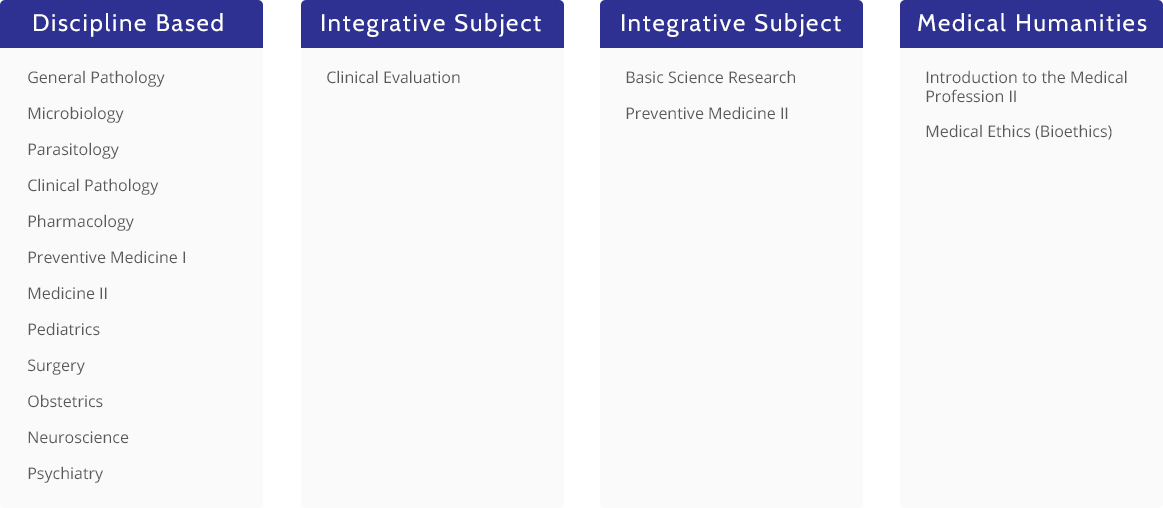
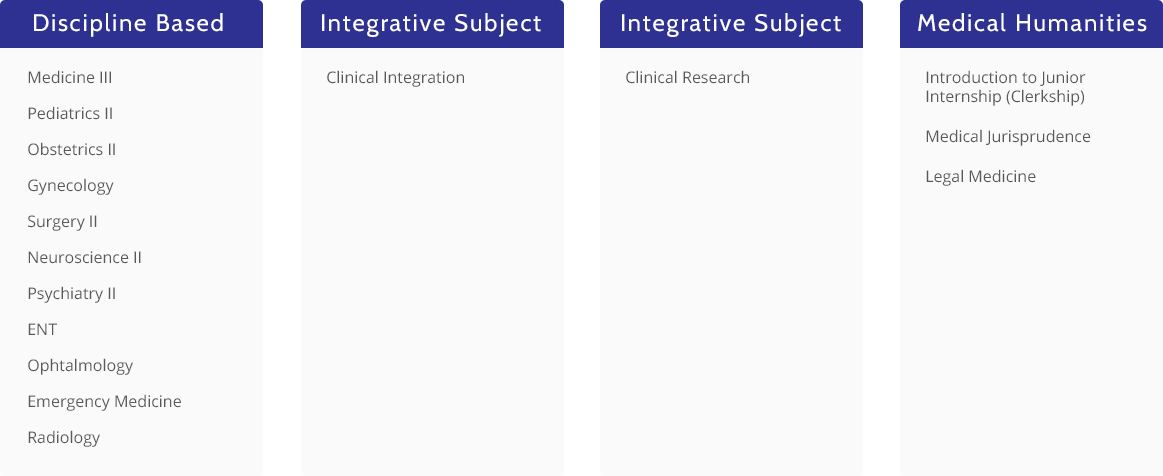
The Doctor of Medicine (MD) Program is delivered over five (5) years, with the first three (3) years (YL 1-3) dedicated to formative basic science and pre-clinical studies, and with the last two (2) years dedicated to Clinical Clerkship (YL 4) and Internship (YL 5), respectively. Courses are clustered into the following content categories: (1) Basic sciences, (2) Clinical sciences, (3) Integrative courses, (4) Research, and (5) Medical ethics and humanities.
In Year Levels 1-3, basic science and preclinical studies are offered alongside unique integrative courses, like Foundations of Medicine (YL 1), Clinical Evaluation (YL 2), and Clinical Integration (YL 3). In the first year, Foundations of Medicine enables students to apply core basic science principles to clinical scenarios while building foundational skills in physical examination and basic history-taking. In Clinical Evaluation and Clinical Integration, the focus shifts to synthesizing knowledge across multiple disciplines to reinforce clinical reasoning, enhance diagnostic proficiency, and develop comprehensive treatment plans.
The College is actively refining its curriculum to create a dynamic, student-centered learning environment that prepares students for the complexities of modern medical practice. Moving away from traditional passive lectures, our updated educational model integrates interactive modalities, blended learning, and synchronized collaborative sessions designed to sharpen clinical reasoning and foster teamwork. By engaging students in team-based learning, parallel cohort learning, and interactive lectures, we ensure that foundational medical knowledge is not merely memorized, but actively applied to real-world patient care from day one.
- Onsite & Online Interactive Lectures: Transitioning away from traditional passive lectures, these strategies utilize interactive technology, active-learning breaks, and real-time audience engagement loops across both physical and virtual classrooms.
- Parallel Cohort Sessions: A highly structured, active-learning model where the class is divided into synchronized, equal cohorts. These sessions balance rigorous, closed-book clinical correlation with deliberate, AI-assisted exploration via College Google Gemini.
- Team-Based Learning (TBL 2.0): The evolution of our initial version of TBL, by upgrading peer accountability, immediate feedback structures, and advanced diagnostic algorithm mapping to ensure students transition smoothly from baseline understanding to collective clinical execution.
By tightly integrating these collaborative strategies, we ensure that our students do not simply memorize medical facts, but actively synthesize and apply them from their very first year in the program.
Research Curriculum
The research curriculum is integrated over five year levels. Research methodology is introduced in YL 1 and applied and carried out, in conjunction with applied epidemiology, in YL 2 under the Department of Preventive & Community Medicine. Biomedical research fundamentals and biosafety standards are also taught in YL 2 during Basic Science Research with SLMC’s Research and Biotechnology Group at the helm. In YL 3, students have Clinical Research, a year-long course focused on critical evaluation of medical literature that culminates in the conduct of systematic reviews and meta-analyses as the final output. In an effort to expand healthcare advocacy research under the thrust of the United Nations’ Sustainable Development Goals and its advocacy towards universal healthcare, the College also offers Service Learning, where students may continue scientific and/or healthcare advocacy research from previous years or start a self-directed, student-led project focused on implementing sustainable health solutions that address a community’s primary care needs (YL 4), and then report their results in a terminal project (YL 5) that consolidates the attainment of program outcomes, particularly those concerning leadership, competence, social engagement, and dedication to service.
This continuum ensures that graduates are not only able to interpret and apply existing research but are also equipped to design, implement, and communicate new knowledge, fulfilling CHED’s Program Outcome 4 (Engage in research activities) and supporting the College’s thrust toward PAASCU Level 3 accreditation.
Clinical Skills Training
The clinical skills curriculum is systematically mapped across all year levels to ensure progressive competency development. In Year Level I, the Foundations of Medicine course introduces students to clinical skills, such as patient-centered interviewing and the basic physical examination procedures. By Year Level II, the Clinical Evaluation course builds on this foundation by equipping students with more advanced techniques in history-taking, physical examination, and specialty-specific skills, guided by faculty from the various clinical departments. In Year Level III, students are further immersed in patient encounters across different departments. During this year, the integrative course Clinical Integration emphasizes a multi-specialty approach through team-based learning (TBL) sessions and case presentations. The pre-clinical phase culminates with individual faculty-supervised patient encounters, followed by an Objective Structured Clinical Examination (OSCE), which serves as a comprehensive assessment of readiness before progression to clerkship.
The College continues to implement the Standardized Patient Program (SPX) and simulation laboratories to enhance student learning throughout the first three years. Complementary technologies such as LAMS, Turnitin, Panopto, IM Portfolio, and Body Interact supplement clinical skills training alongside direct, in-person patient encounters.
All curricular content is accessible online via the Learning Management System Cypher Learning, the official Learning Management System of SLMCCM. To further support learning, the College library provides access to essential online resources, including AccessMedicine, ClinicalKey, Ovid, and UpToDate, facilitating remote and self-directed study.
Independent study hours are designated periods when students engage in self-directed learning outside scheduled instructional sessions. These activities may include reviewing course materials, reading assigned references, completing learning tasks, preparing for assessments, and pursuing further study to achieve the intended learning outcomes.
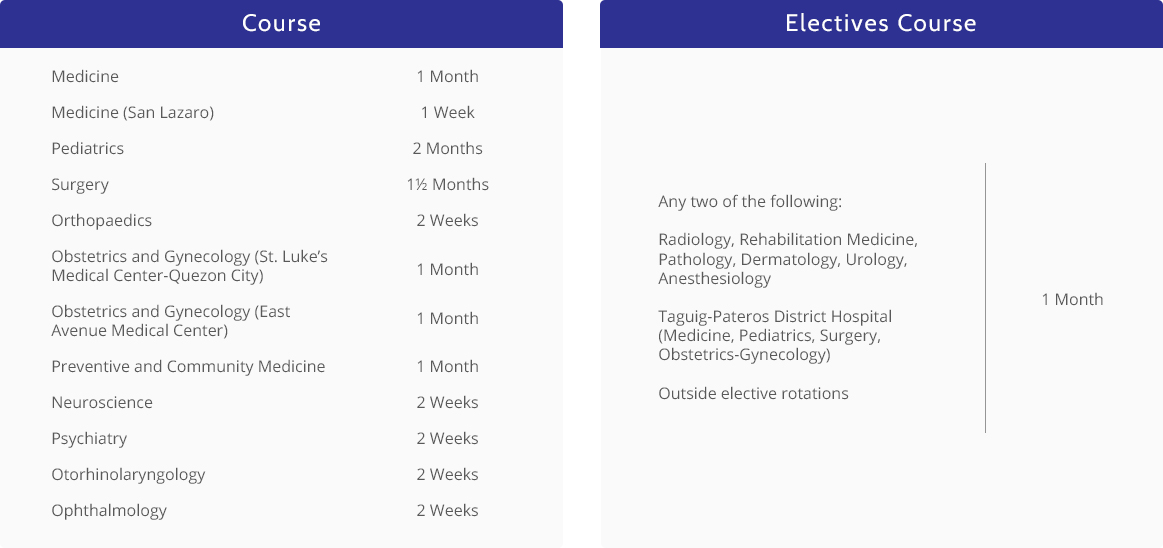
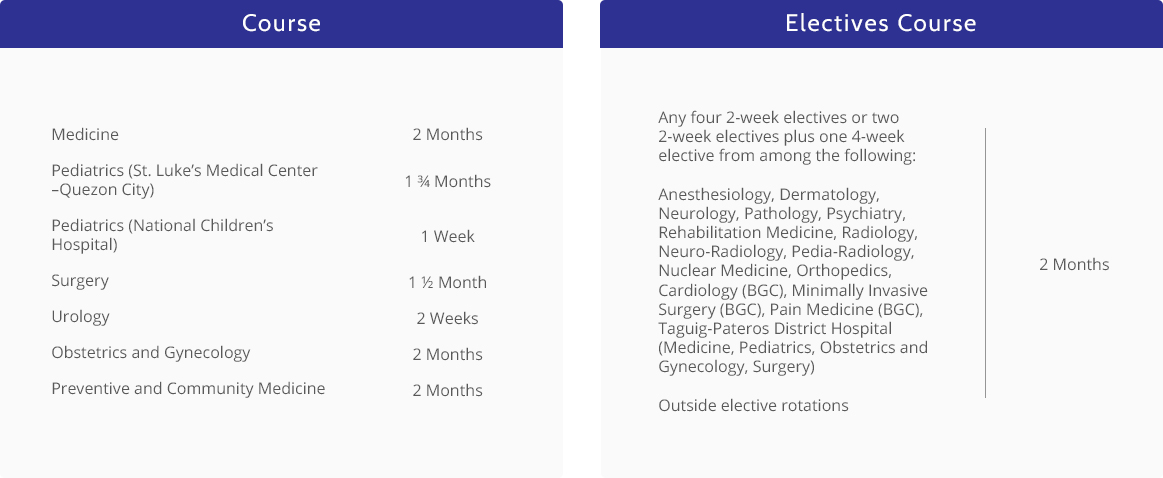
The fourth and fifth years of training are conducted primarily at St. Luke’s Medical Center – Quezon City, with additional clinical exposure at St. Luke’s Medical Center – Global City and other affiliated hospitals and medical centers. Students also have the opportunity to undertake elective rotations in their preferred medical specialties, either locally or internationally, providing a broader scope of clinical experience and specialized learning.

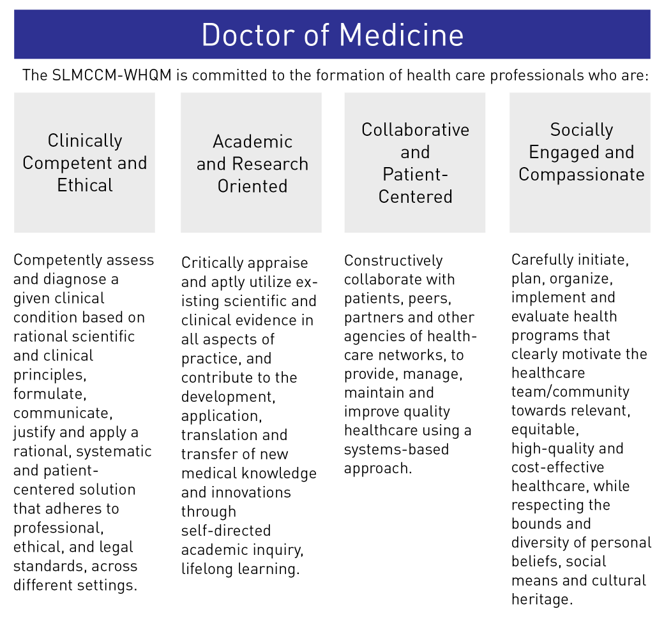
Institutional and Program Outcomes
Aligned with the Commission of Higher Education (CHED) program outcomes for medicine, the four College institutional outcomes reflect our institutional mission, vision and goals, and embody the ideal attributes of an SLMC-CM WHQM graduate.